
We’ve all been there. You boldly block out two hours on your calendar for a massive project. You sit down, crack your knuckles, and… end up staring at a blinking cursor before mindlessly opening a new tab to check your email for the fifteenth time today.
Maintaining unshakeable focus is brutal right now. Our brains are absolutely fried by cheap dopamine and constant notifications. But what if you could put on a pair of headphones and literally tune your brain waves into a state of intense concentration?
If you want to know exactly how to use binaural beats for deep work sessions, you are in the right place. I’ve spent the last decade testing every productivity hack under the sun, and this specific audio strategy is one of the few that genuinely works. Today, I’m going to show you how to leverage this auditory illusion to trick your brain into peak performance.
Why Your Brain Naturally Rejects Deep Work
We are not wired for the modern digital workplace.
Every time your phone buzzes or Slack pings, your brain gets a tiny hit of dopamine. Deep work, on the other hand, is hard. It requires burning significant cognitive calories to stay locked onto a single, complex task without immediate reward.
When you sit down to write a strategy brief or code a new feature, your brain actively looks for an escape route. And the cost of giving in is steep. Research shows it takes an average of 23 minutes to regain your initial level of focus after a single distraction [Insert External Link: Study on the cost of interrupted work].
You don’t need more willpower. You need a way to build a wall around your attention.
The Science Behind Binaural Beats for Deep Work Sessions
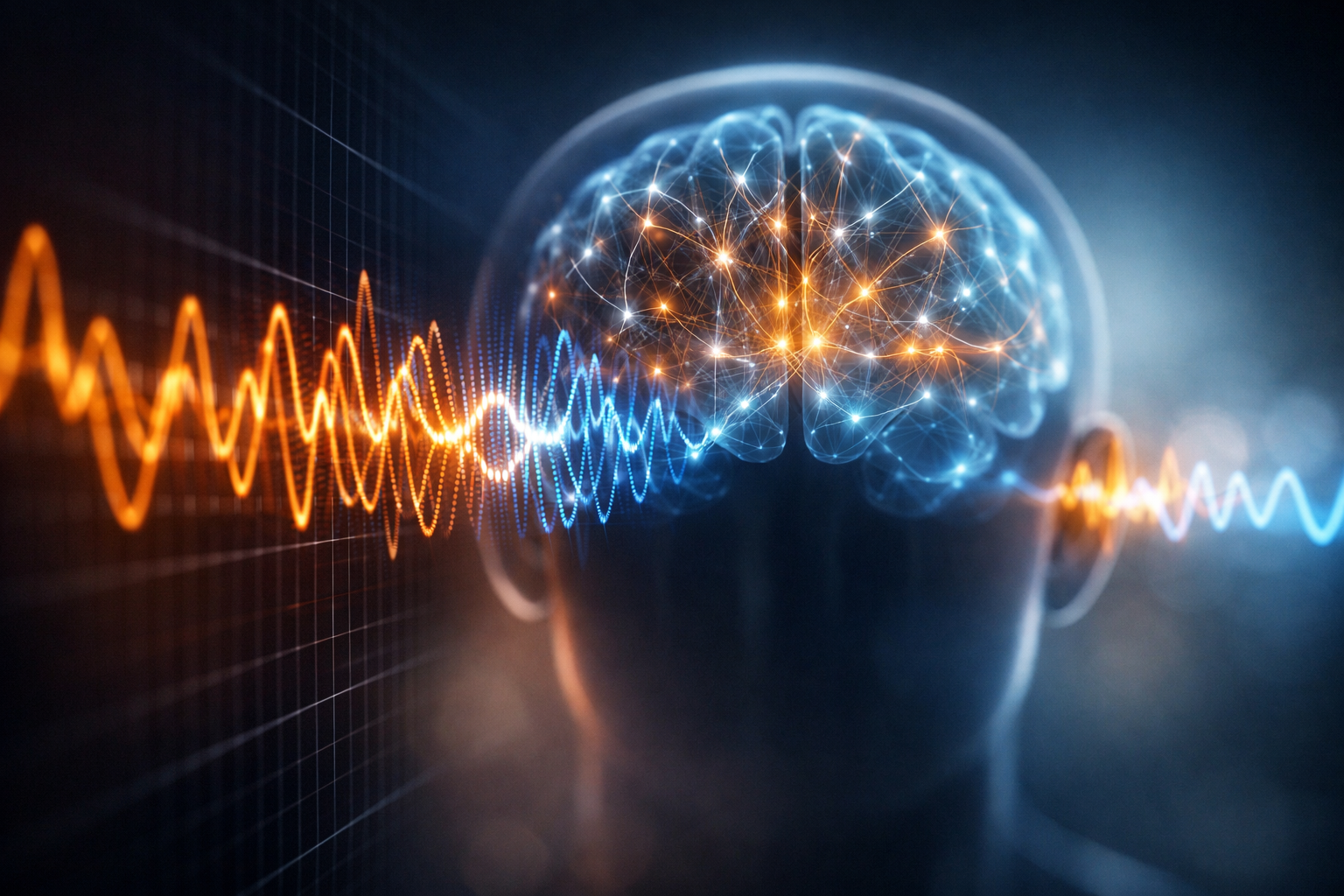
Before we get to the practical steps, let’s clear up what we are actually talking about. Binaural beats are not magic, nor are they a new-age gimmick. They rely on a well-documented neurological phenomenon called brainwave entrainment.
Here is how the illusion works:
- You play a tone of 200 Hz in your left ear.
- You play a tone of 215 Hz in your right ear.
- Your brain gets confused by the discrepancy and “hears” a third phantom beat at a frequency of 15 Hz.
More importantly, your brain waves naturally begin to sync up with that new 15 Hz frequency. By choosing specific frequencies, we can force the brain to shift out of a scattered, distracted state and into a highly focused, flow-like state.
How to Use Binaural Beats for Deep Work Sessions: A Practical Guide
Slapping on any random YouTube playlist labeled “focus music” won’t cut it. To actually see results, you need a targeted approach. Here is my exact protocol.
1. Choose the Right Brainwave State
Different frequencies trigger different cognitive states. If you choose the wrong one, you might end up falling asleep at your keyboard instead of crushing your to-do list.
- Beta Waves (14 to 30 Hz): This is your bread and butter for deep work. Beta waves are associated with high-level concentration, analytical thinking, and alert problem-solving. Use this when you are doing taxes, coding, or writing a dense report.
- Alpha Waves (8 to 14 Hz): Alpha frequencies promote relaxed focus. This is the “flow state” zone. It’s perfect for creative tasks like designing graphics, brainstorming, or writing a blog post where you need ideas to flow without overthinking.
- Theta Waves (4 to 8 Hz): These are for deep relaxation and meditation. Avoid these during work sessions unless you are doing a quick mid-day recharge.
2. Gear Up Properly
You absolutely must use stereo headphones.
Because the entire concept relies on feeding a different frequency into each ear separately, playing binaural beats through your laptop speakers or a Bluetooth room speaker does absolutely nothing.
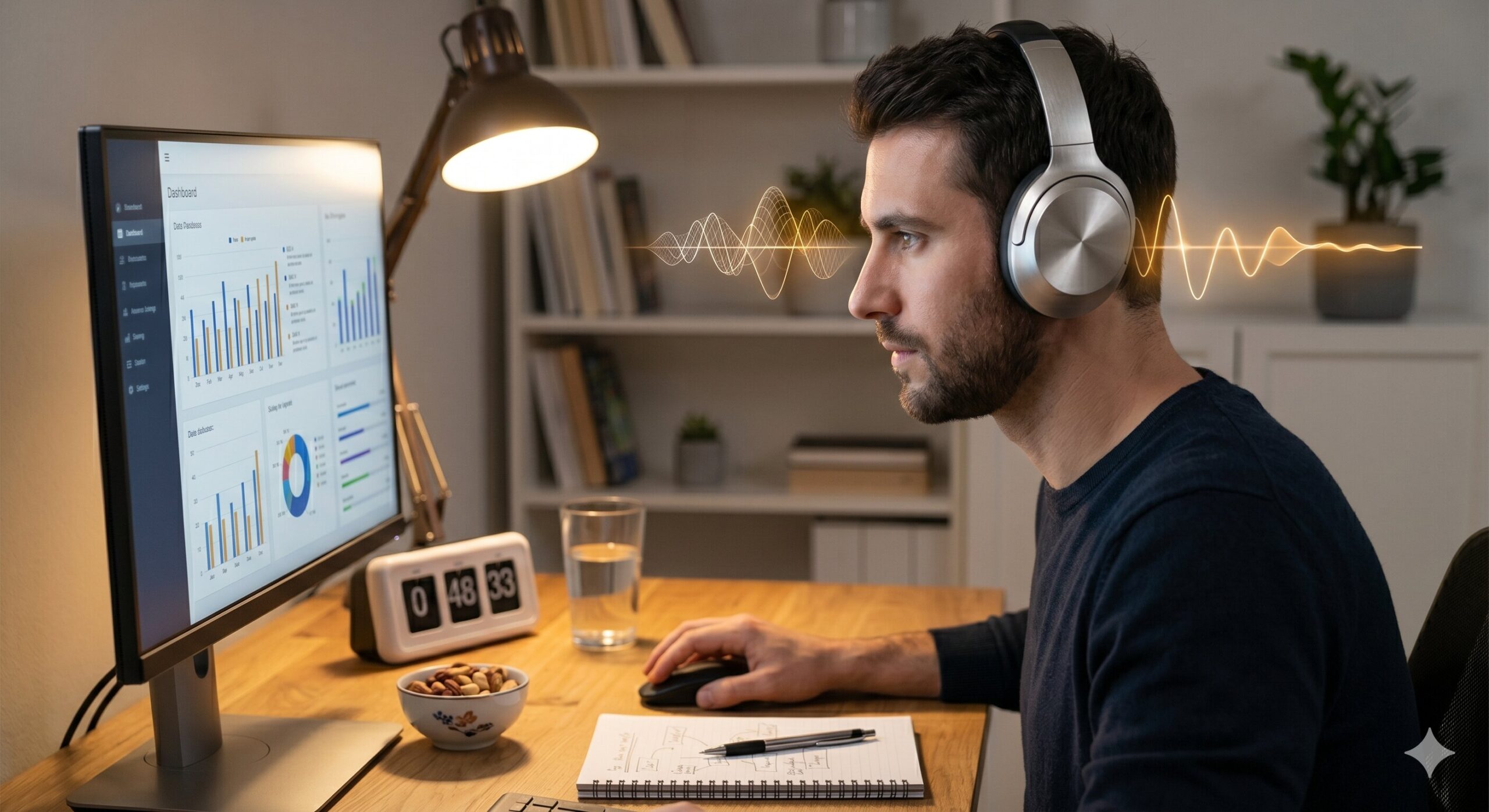
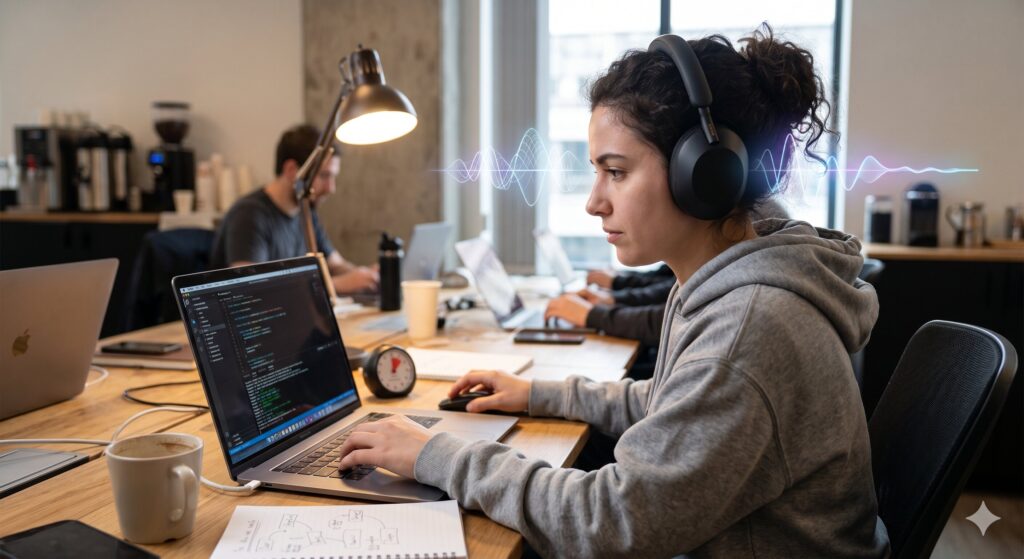
I highly recommend using over-ear, active noise-canceling headphones [Insert Internal Link: Our top picks for productivity headphones]. The physical isolation from your environment combined with the audio entrainment creates the ultimate focus bubble.
3. Stack It With the Pomodoro Technique
Binaural beats work best when you give your brain clear boundaries. I never listen to them for eight hours straight; that just leads to auditory fatigue.
Instead, use them alongside time-blocking. Set a timer for 60 to 90 minutes. Put your phone in another room, start your Beta-wave track, and do not stop working until the timer goes off. When the session ends, take the headphones off and give your brain a 15-minute break in silence.
The Missing Link in Your Productivity Routine
Audio hacks are incredibly effective for locking in your attention, but they can’t fix a broken biological foundation. You can’t out-hack a terrible diet, chronic exhaustion, or a sluggish metabolism.
If you find yourself staring at your screen feeling totally drained before you even put your headphones on, you need to address your physical stamina first. Binaural beats are the steering wheel, but your body is the engine. To get that engine running hot and perfectly complement your new deep work sessions, you need to fuel up right. I highly recommend checking out my absolute favorite resource to naturally supercharge your daily stamina: head over to https://wholesomequests.com/energizer to get your physical energy matching your newfound mental focus.
Final Thoughts
Deep work is the ultimate competitive advantage in a distracted world. The people who can sit down, tune out the noise, and produce high-quality work are the ones who win. Binaural beats are simply a tool to help you get into that lucrative zone faster and stay there longer. Grab your headphones, pick a Beta frequency track, and watch how quickly your to-do list disappears today.
Frequently Asked Questions (FAQ)
Do I need an expensive app to listen to binaural beats? No. While there are dedicated premium apps like Brain.fm or Endel that offer highly curated experiences, you can find thousands of free, high-quality binaural beat tracks on Spotify, Apple Music, or YouTube. Just ensure you are actually wearing headphones.
Can I listen to my own music over binaural beats? Yes! Many people find the pure humming sound of binaural beats a bit grating on its own. You can layer ambient music, rain sounds, or lo-fi beats over the top of the raw frequencies, provided the track itself doesn’t have distracting vocals.
Are binaural beats safe for everyone? For the vast majority of people, they are completely safe. However, because they directly influence brainwave activity, people who suffer from seizures or epilepsy should consult a doctor before using them.
How long does it take for the brain to sync with the audio? Most research suggests it takes your brain roughly 7 to 10 minutes to fully “entrain” or sync up with the target frequency. Don’t quit if you don’t feel laser-focused in the first 30 seconds; give your brain time to adjust to the auditory input.